Best Math Games for the Classroom (K–12): A Teacher's Guide
Classroom games have a different job than home apps. They have to work for 25 students and one screen, fit into a class period, and match the standards you're teaching this week. A game that's great at home can fall apart in a classroom.
If you're looking for math games for your classroom, the first question isn't "is it fun?" It's "will it work in my room?" Here's what to look for, a starting list for every grade band, and how to use math games in each part of a lesson.
What a classroom math game needs
- It works on one shared screen. Whole-class team play on a smartboard, or one Chromebook per table for stations.
- No logins. Getting 25 students signed in can eat half the period.
- It matches your standards. You should be able to tell which standards a game practices before you use it.
- It survives bad WiFi. School networks drop, filters block game sites, and testing season eats bandwidth. Offline games don't care.
- Short rounds. You need something that fits in 10 to 20 minutes, not a game that needs an hour to get going.
Every Fletcher Math game was built around that list by a middle school math teacher. Each one is a single file that plays offline, has no student accounts, and lists the standards it covers.
Kindergarten to 2nd grade
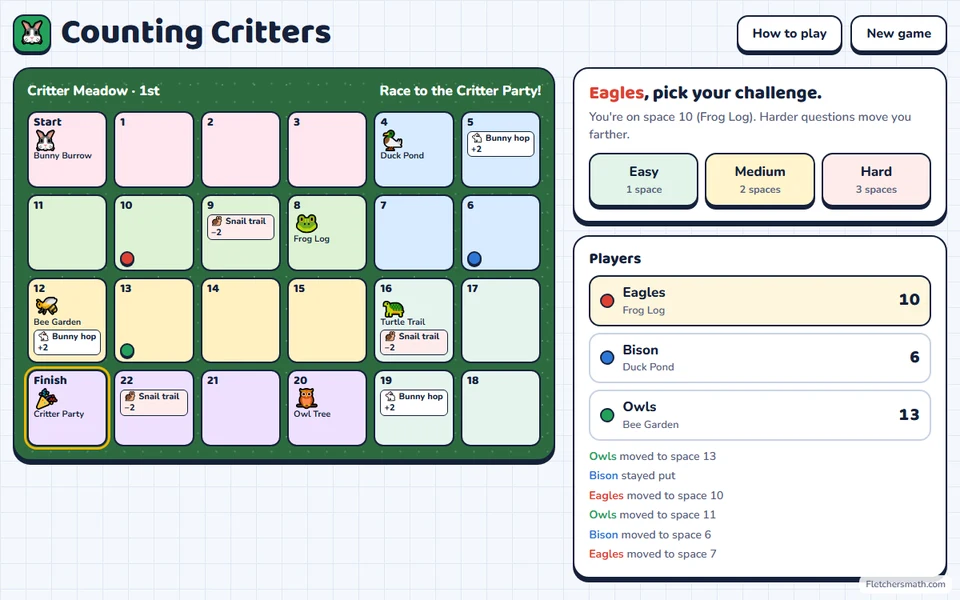
- Counting Critters: Counting, comparing, making 10, adding and subtracting.
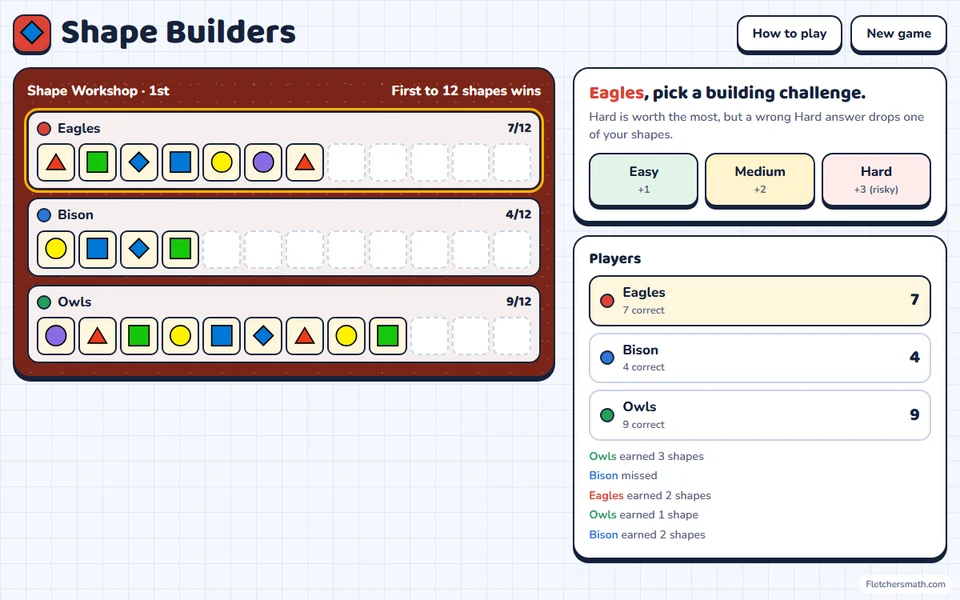
- Shape Builders: Flat and solid shapes, sides and corners, and equal parts.
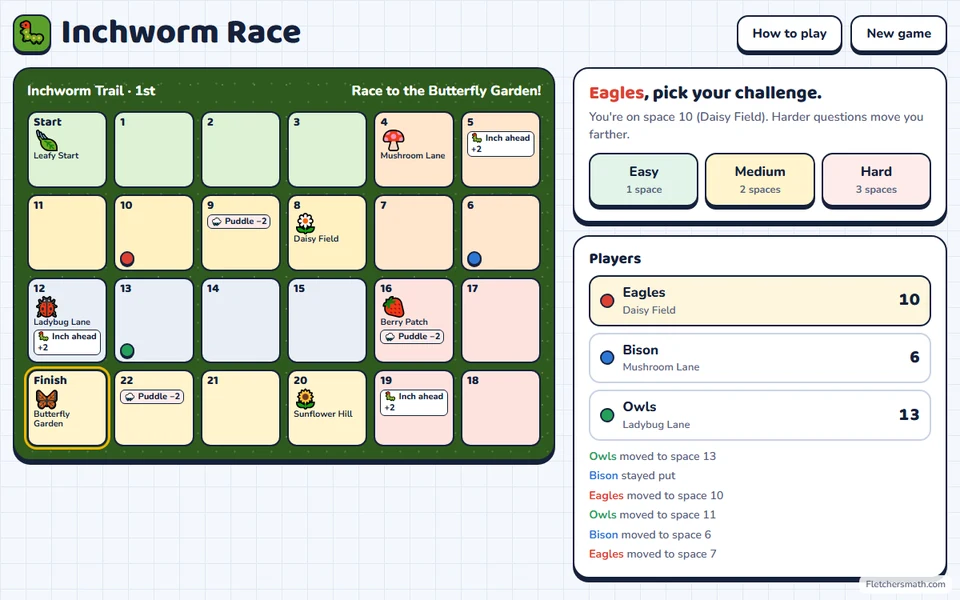
- Inchworm Race: Comparing and measuring length.
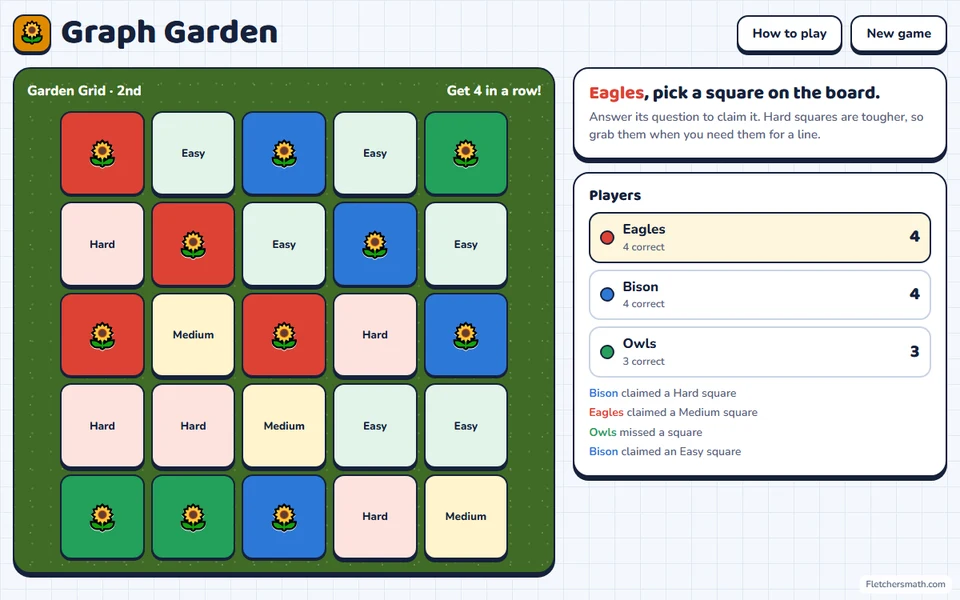
- Graph Garden: Tally charts, picture graphs and bar graphs, with a 4-in-a-row board.
More: Kindergarten, 1st grade and 2nd grade math games.
3rd to 5th grade
- Who's Multiplying?: Multiplication facts in a strategy game.
- Fraction Line Leap and Fraction Frenzy: Fractions on a number line, equivalent fractions, comparing and operations.
- Split or Stack: Multi-digit multiplication with the area model or the standard algorithm, where teams check each other's work.
- Story Problem Safari: Multi-step word problems.
- Cube Quest: Volume with unit cubes, layers and V = l × w × h.
6th to 8th grade
- Balance It!: Solving equations by keeping the scale balanced. Miss a step and the next player can steal it.
- Ratio Rummy and Percent Shopping Spree: Unit rates, proportions, discounts, tax and tips.
- Integer Expedition: Integers, rational numbers, exponents and order of operations.
- Slope Ski Run and Function Junction: Slope, intercepts and functions.
- Galaxy Race: The Pythagorean theorem, scientific notation and exponent rules.
See the full 7th grade and 8th grade lists.
High school
- Algebra 1: Solve-It Showdown, Laser Line Up, Factor Forge and Quadratic Quest.
- Geometry: If-Then Courtroom, Congruence Clash, Trig Tower and Circle Spinners.
- Algebra 2 and Precalculus: Logarithm Lodge, Polynomial Power-Up, Unit Circle Spin and Conic Constellations.
Games that span grades
Some games work across grades 3–8 because you pick the grade on the start screen and the problems change to match. These are great for review days and for teachers who have more than one grade: Math Mogul, Math Racing League, Math Escape Room, Math Detective Agency and Around the World Math.
How to use math games in class, by purpose
Rather than choosing games only by grade level, start with the instructional moment. The same topic can call for different formats depending on whether students are learning, practicing, reviewing, or extending a skill.
Warm-ups that get students thinking
A short game at the beginning of class can activate prior knowledge without turning the opening routine into a worksheet. For primary grades, that may mean identifying numerals, counting objects, comparing quantities, or composing numbers. In upper elementary, it can be a quick multiplication, fraction, or place value challenge.
For middle and high school, warm-ups work well when they revisit prerequisite skills. An equation-solving game before a linear functions lesson, for example, can reveal whether students are ready for the day’s work. A geometry vocabulary game can bring terms back to the surface before students begin a proof.
Keep these games brief. Five to ten minutes is usually enough to build momentum while protecting time for new instruction. If a warm-up exposes a widespread misconception, pause the game and use the result. That is formative assessment doing its job.
Centers and small-group practice
Centers are where independent game play can be especially useful. One group may work with the teacher, another may use manipulatives, and another may practice a targeted skill through a digital game. The game station needs clear directions and feedback students can understand on their own.
In early grades, center games can reinforce counting, addition and subtraction facts, shapes, measurement, and basic data. In grades 3-5, teachers can rotate students through multiplication, division, fractions, decimals, and coordinate graphing practice. The benefit is not simply keeping students occupied. It is giving them repeated, focused encounters with a skill while the teacher works intensively with another group.
For intervention, choose a game with a narrow target. A student struggling with equivalent fractions does not need a broad grade-level review first. They need enough practice on equivalent fractions to recognize the relationship, receive feedback, and try again. Narrow games make it easier to differentiate without announcing who is working below grade level.
Whole-class review that includes everyone
Whole-class games can bring real energy to review days, especially when projected on an interactive smartboard. But competition needs a few guardrails. Fast-answer formats can favor students who already feel confident, while students who need more processing time may stop participating.
A better approach is to build in think time before answers are shared. Let partners solve first, then invite teams to explain their reasoning. Rotate who reports for each group. If the game has a point system, consider awarding points for accurate reasoning as well as correct answers.
This format works across grade bands. Elementary students can discuss how they found the sum or which fraction is larger. Middle school students can defend an integer operation or proportional relationship. High school students can compare methods for factoring, graphing functions, or simplifying expressions. The game supplies the prompt; the mathematical conversation supplies the depth.
Review before a quiz or unit test
Review games are most effective when they are organized around a manageable set of standards. A giant mixed-skills game can show students how much they remember, but it can also hide what they still need to practice. Consider using one game for a focused skill review and another that mixes skills closer to the assessment.
For example, a Grade 6 review might move from ratios to unit rates to percent problems. An Algebra 2 review might separate polynomial operations from solving quadratic equations before combining both in a final round. Students get a clearer sense of what they know, and teachers get cleaner information for the next day’s review group.
Avoid making a game the only review method. Students still need time to work problems on paper, show steps, and ask questions about errors. The game is a high-participation practice tool, not a replacement for mathematical writing or teacher feedback.
Match the game to the math, not just the grade
Grade bands are helpful, but they are only the starting point. A fourth-grade class may need multiplication fact fluency, fraction concepts, or multi-step word problem practice. Those are very different needs. The same is true in secondary classrooms, where an Algebra 1 student may be ready to graph linear equations but still need support with integer operations.
Before selecting a game, ask three quick questions: What standard or skill is the target? What will students need to do to show understanding? What kind of feedback do they need while practicing?
A good match has students doing the same kind of thinking they will need in the lesson or assessment. If students will need to solve equations and justify each step, choose a game that asks them to solve equations, not one that only asks them to identify vocabulary. Vocabulary can be useful, but it should support the main objective rather than stand in for it.
Standards alignment matters here because it helps teachers avoid random practice. It also makes game-based instruction easier to explain to a coach, administrator, or department chair. The game is not a reward after the learning. It is structured practice tied to a specific learning goal.
Plan for participation, not just competition
The best game routines make it hard for students to disappear. During partner play, give each student a role such as reader, solver, checker, or explainer, then switch roles after a few questions. In teams, ask everyone to record an answer before the group submits one. During whole-class play, use mini whiteboards or paper workspaces so every student solves, not just the student holding the device.
There is also a place for friendly competition. Many students respond well to a visible score, a timed challenge, or a class-versus-game format. Still, it depends on the group. A highly competitive format may motivate one class and raise anxiety in another. If students are hesitant, try cooperative goals: Can the class reach a target score? Can each team improve from round one to round two? Can students explain three different solution paths?
When students know that thinking matters as much as speed, math games become more welcoming. That is especially valuable for learners who have decided they are "not math people." A well-chosen game gives them another entry point: try, get feedback, revise, and contribute.
A classroom game does not have to carry the entire lesson. It just has to make one important part of the lesson work better. Choose a focused skill, protect a few minutes for student thinking, and let the next round of questions show you where to teach next.
Want to see how they fit your year? The free curriculum guide lists each unit for every grade, its standards, and the games that match.
Common questions
How many students can play at once?
Up to 6 players or teams share one screen. For a whole class, split into teams on the smartboard. For stations, put one game on each table's Chromebook.
Which standards do the games cover?
Every game lists the Common Core standards it practices, and many are also aligned to the Oklahoma Academic Standards. You can browse games by standard.
What does it cost?
Games are $5 each. The Teacher License is $150 for all 266 games plus every future game, and there are School and District licenses too.